There’s a quiet moment no one prepares you for.
The morning you wake up and realize… the hunger is back.
It’s not just physical.
It’s layered—part craving, part confusion, part fear.
You’ve done the work. You changed the habits. You felt lighter, more in control, more you.
But now, the appetite that once felt tamed whispers again. And that whisper becomes a roar.
If you’ve been on a GLP-1 medication such as Ozempic, you know what I mean. For months, maybe even a year, food didn’t call your name the same way. It was as if someone finally turned down the noise inside your head—the constant “Should I eat this? Should I not?”
And then, one day, that noise returns.
The question isn’t, “What’s wrong with me?”
The real question is, “What is my hunger trying to tell me now?”
Why Hunger Returns After Ozempic
Your body isn’t betraying you—it’s communicating with you.
When you stop Ozempic or other GLP-1 inhibitors, the body recalibrates. These medications slow digestion, balance blood sugar, and quiet hunger hormones like ghrelin and leptin. They buy you time to reset patterns—but they don’t erase the wiring built over years.
When the medication leaves, hunger often returns stronger.
Not because you’re weak, but because your body’s survival system says, “Hey, I can feel again.”
That’s not failure. That’s feedback.
Research shows that once GLP-1 treatment ends, many people experience renewed appetite and partial weight regain as hormone levels normalize.[¹]
A Moment That Changed My Perspective
While I was on vacation recently, I sat down to dinner at a beautiful restaurant high in the mountains.
I wasn’t hungry—not even a little. I’d been fighting altitude sickness for days.
As I looked at the food in front of me—vibrant colors, the aroma of spices, laughter echoing around the table—I felt something unexpected.
I wanted to eat. I wanted to enjoy it.
But I couldn’t. My stomach turned at the thought of food.
And it hit me: This must be what my clients feel like when they’re on GLP-1 medications such as Ozempic.
That hollow disconnection between desire and ability—the body refusing what the mind craves—is miserable.
I remember taking one tiny forkful, thinking, “Wow, how delicious this is… but I just can’t eat it.”
That is not a way to live.
We weren’t designed to mute hunger forever.
We were designed to understand it.
When I finally recovered, my appetite returned—and with it, gratitude. Gratitude for being able to eat consciously, to feel hunger, and to make intentional choices again.
That’s what this work is about: awareness, intention, connection.
The Science and Psychology of Post-Ozempic Hunger
When you stop Ozempic, your body and brain start communicating in full sentences again:
- Ghrelin (the hunger hormone) rises, while leptin (the fullness cue) drops.[²]
- Your stomach empties faster, so hunger arrives sooner.
- Your dopamine reward circuit lights back up—food feels emotionally charged again.
- And the old mental patterns around comfort, reward, and stress reappear.
You’re not fighting hunger—you’re meeting yourself again.
This is where awareness bridges biology and behavior.
Awareness Over Willpower: The 3P Reset
You don’t need more willpower. You need awareness.
Willpower is a sprint; awareness is endurance.
When you slow down enough to notice the urge—not fight it, not feed it—you reclaim choice.
That space between stimulus and response is where transformation lives.
In the B3 Way, we call it “the pause that rewires your power.”
Try This: The 3P Reset
- Pause – Take one slow breath. Let your body speak.
- Probe – Ask, “What kind of hunger is this?”
- Stomach hunger: my body needs fuel.
- Mouth hunger: I want stimulation.
- Mind hunger: I’m anxious or bored.
- Plan – Choose your next best bite, not a perfect day.
Each time you do this, you quiet the inner critic and strengthen the inner coach.
From Dependence to Decision: Building an Intentional Eating System
Ozempic may have been your bridge—now it’s time to build the foundation.
You don’t need another diet.
You need a decision system that helps you stay intentional when the hunger returns.
That’s the purpose of the Better Bite Buddy™ and the B3 Way.
It’s not a diet—it’s a framework for pausing, choosing, and leading each bite with clarity.
Because hunger will return. And that’s okay.
It means your body is alive again.
Rebuilding Your Rhythm After GLP-1 Medication
When medication fades, rhythm replaces it.
- Set meal windows – consistent, not rigid, to rebuild circadian rhythm.
- Lead with protein + fiber – your natural hunger anchors.
- Hydrate before hunger – dehydration often mimics appetite.
- Move after meals – a 10-minute walk balances glucose and mindset.
- Reflect nightly – ask, “Where did I eat with awareness? Where did I react?”
A recent clinical review found that establishing structured eating routines and physical activity significantly reduces post-GLP-1 weight regain.[³]
Structure doesn’t restrict you—it supports you.
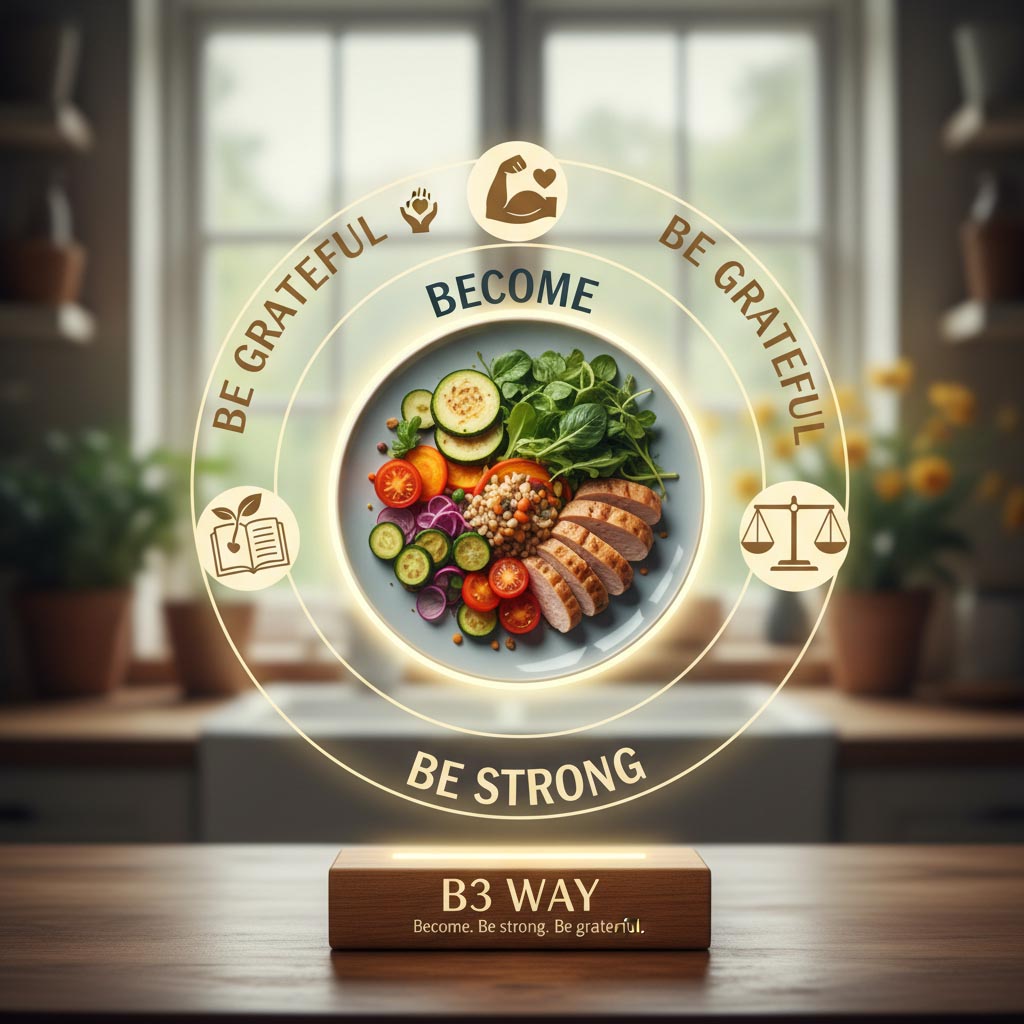
Become. Be Strong. Be Grateful.
You’re not losing control.
You’re regaining connection.
You’re learning to listen to your body again—without filters, without shame.
The medication was a teacher. Now, you’re the leader.
That’s the B3 Way in motion:
Become. Be Strong. Be Grateful.
Turning Hunger Into a Teacher
Hunger isn’t punishment. It’s participation.
When you feel hunger again, you’re reconnecting with the wisdom that’s always been there.
It’s your body saying, “I trust you to listen again.”
To feel hunger is to be alive.
To respond with intention is to be free.
You don’t need a quieter stomach—you need a calmer mind.
You don’t need more willpower—you need more awareness.
References
[1] Hackensack Meridian Health. “Life After Ozempic: The Decision to Stop and What Comes Next.” (2024)
[2] Healthline. “How to Manage Extreme Hunger When You Stop Taking Ozempic.” (2024)
[3] Harvard Health Publishing. “What Happens When You Stop Taking GLP-1 Drugs Like Ozempic?” (2024)
Ready to Lead Your Health With Intention?
Start your journey with the Better Bite Buddy™, a system that helps you manage post-Ozempic hunger with clarity instead of control.
👉 Start Better Bite Buddy™
👉 Take the Inner Critic Quiz
👉 Schedule your free “First Step” consultation
Keep the Momentum Going!
If you’re ready to take control of your health, mindset, and leadership, here are your next steps:
- Subscribe on LinkedIn: Join the community of leaders who are leveling up their health and life. Follow me here for daily insights and tips.
- Join Optimized Health for Leaders: Our exclusive Facebook group is where the conversation deepens. Get access to a supportive network of like-minded leaders who are committed to intentional health. Click here to join the group!
- Watch the Latest Podcast: Tune in to the latest episode where I discuss practical strategies for living with more energy, confidence, and focus. Watch it here.
- Work with Me: If you’re ready for a personalized plan that helps you overcome your inner critic and achieve your health goals, schedule a consultation today. Let’s talk.